
Introduction
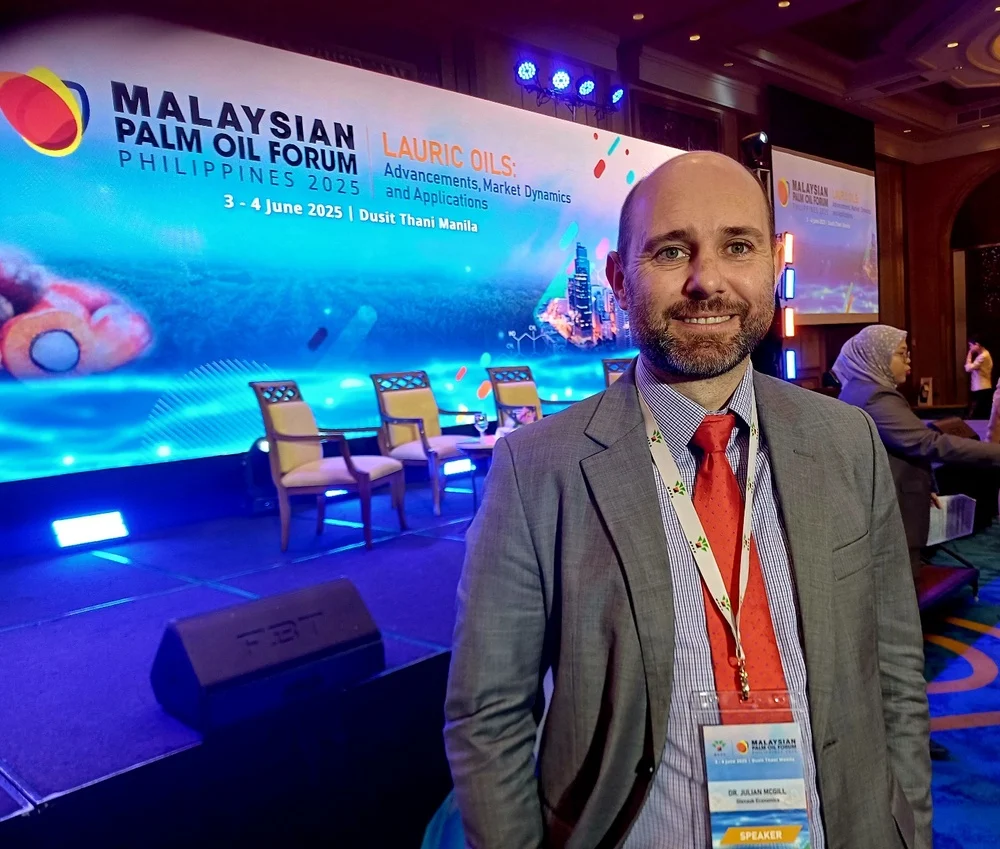
When Julian McGill presented his outlook on lauric oils at the Malaysian Palm Oil Forum in the Philippines, it wasn’t just a routine market update. It was a glimpse into the delicate, brittle ecosystem that underpins the global fats and oleochemicals industries — one increasingly defined by supply constraints, shifting consumer preferences, and the stubborn reality of agronomic neglect.
Lauric oils, particularly palm kernel oil (PKO) and coconut oil, have always occupied a peculiar niche in the edible oils universe. While soybean, canola, and palm oils slug it out in mass-volume, price-sensitive markets, lauric oils are indispensable for a very narrow band of applications: specialty fats in confectionery and, crucially, oleochemicals like detergents and surfactants. They’re the only reliable, scalable source of C12-C14 lauric acids.
The trouble is, there are no easy alternatives.
And there in lies the problem.
A Market Without Alternatives, and Without a Plan
The current rally in lauric oil prices is not just another cycle. It’s a sign of a market systemically ill-equipped to deal with disruption. As McGill pointed out, PKO production growth has stagnated, constrained by limited palm planting expansion, genetic varieties favouring oil yield over kernel share, and the El Niño-linked drought cycles that keep playing havoc with fruiting patterns.
Meanwhile, coconut oil — which once offered some balancing flexibility — has become a victim of its own agronomic neglect.
The coconut industry, fragmented and underfunded, has failed to invest in high-yielding varieties or replanting programmes.
It’s an aging orchard waiting for the next typhoon to do its worst.
The result: an extraordinary premium for coconut oil, a PKO market with no safety valve, and a dangerous reliance on Indonesia’s domestic policies, which now increasingly prioritise in-country processing over raw exports. In short, global lauric oil supply is not keeping up — and unlike soybean or sunflower oil, it can’t be easily substituted.
Why Demand Destruction Is Now the Market’s Only Lever
McGill makes a pertinent observation: higher cocoa prices should have encouraged more cocoa butter substitutes (CBS) use — chiefly made from lauric oils like PKO stearin. But instead of a substitution surge, we saw demand destruction.
Chocolate production in Germany fell sharply in 2024 as consumers pivoted to smaller, more premium offerings, and manufacturers hesitated to reformulate recipes that might alienate their market base.
This pattern of demand destruction is likely to intensify in oleochemicals too. With mid-cut alcohol prices sky-high, manufacturers will be forced to rationalise formulations, perhaps substituting synthetics where possible, or limiting product ranges.
Ironically, the oleochemical sector — long touted as palm oil’s environmentally friendly, sustainable alternative to petroleum derivatives — may see petrochemical fatty alcohols stage a comeback on sheer price grounds
The Structural Fragility of Lauric Supply
What this episode highlights is the structural fragility of the lauric oils market. A few years of weather disruption, policy shifts, and underinvestment, and suddenly an entire industrial category teeters.
There’s little capacity for rapid supply-side response. Coconut replanting takes 6–8 years to come on stream. Palm kernels are a by-product, and breeding for higher kernel yields runs counter to the industry’s drive for oil productivity.
This isn’t just an economic challenge; it’s a strategic one. Lauric oils underpin crucial sectors — from personal care to pharmaceuticals. The world can survive pricier soybean oil for frying. It cannot run detergents without lauric acids.
The Road Ahead: Consolidation, R&D, and Diversification
So where do we go from here? Three things are clear:
- Downstream integration will accelerate — expect Indonesia’s oleochemical sector to grow rapidly, reducing PKO availability for export, while Malaysia may need to reposition itself towards higher-value specialty fats rather than bulk oleochemicals.
- R&D in alternative lauric sources is overdue — be it through improved coconut agronomy, synthetic biology approaches to tailored fatty acid production, or scaling up other exotic oilseeds like babassu and cupuaçu.
- Market diversification is inevitable — oleochemical producers will need to relook at synthetic and alternative feedstocks as insurance against PKO price volatility.
Conclusion: The Era of Cheap Laurics is Over
In essence, McGill’s talk wasn’t just a presentation of numbers — it was a warning. The lauric oil sector has coasted on complacency for too long, assuming the supply would always be there. It won’t. The industry now faces a future where supply discipline, agronomic investment, and downstream integration will decide winners from losers.
And for those still hoping for a price correction? Be careful what you wish for. The days of cheap, abundant laurics are over — and what’s ahead is a market that rewards resilience, foresight, and the courage to innovate.